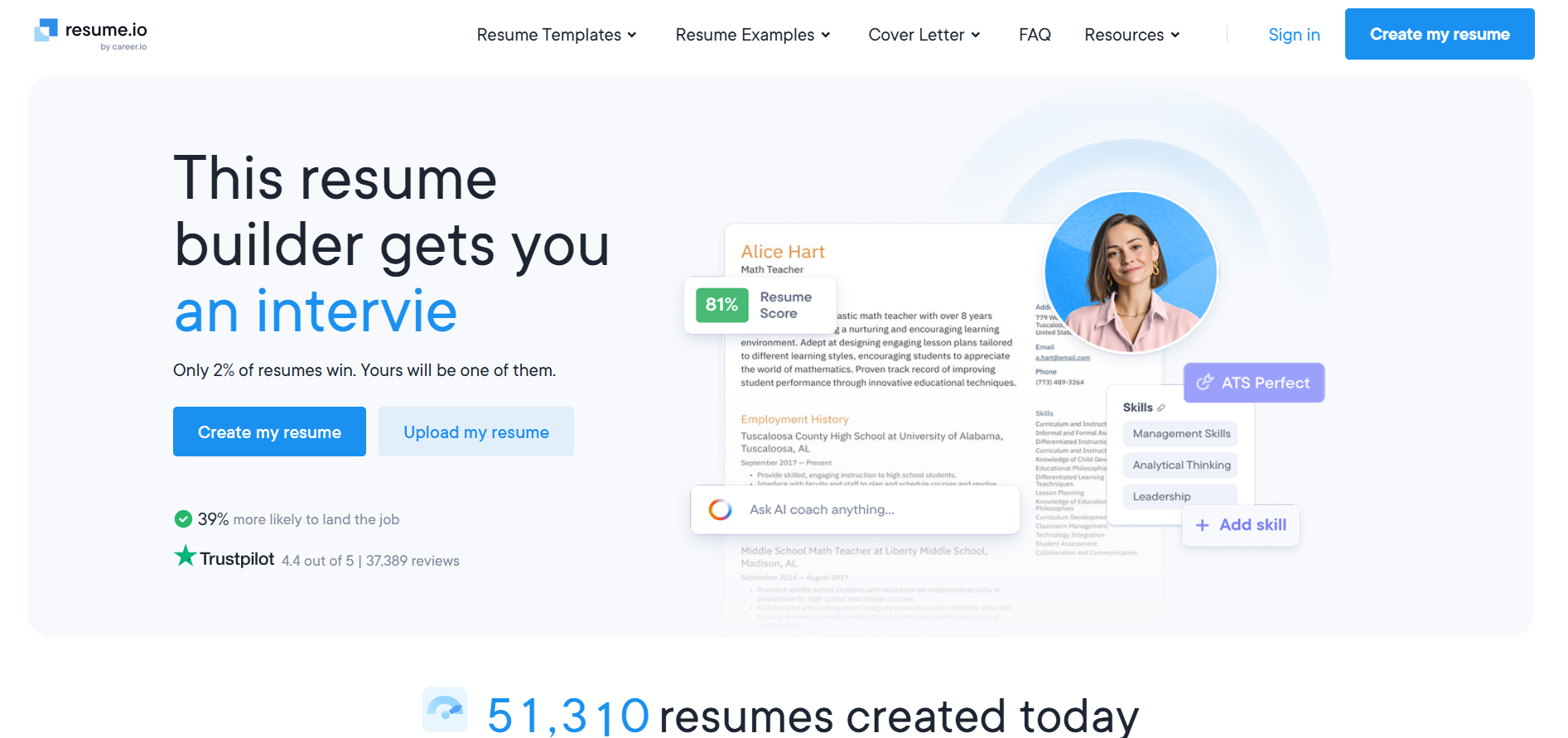
In 2026, getting noticed by recruiters requires far more than just listing your past job titles. Modern employers rely heavily on Applicant Tracking Systems (ATS) and automated screening tools to filter out applications before a hiring manager ever sees them. Because of this, job seekers need an AI resume builder that creates tailored, ATS resume builder documents designed specifically for modern hiring software.
For this updated Resume.io review, I spent multiple sessions hands-on testing the Resume.io AI Resume Builder for Resume.io 2026. During my testing, I thoroughly evaluated its AI writing quality, ATS optimization, resume templates, cover letter generation, resume customization, job matching, ease of use, Resume.io pricing, and overall user experience. I also compared Resume.io side-by-side with other leading AI resume builders like Rezi, Kickresume, and Teal to see how it performs in real-world scenarios.
Rather than acting like a generic AI writing tool that produces robotic text, Resume.io uses recruiter-trained AI tailored for job applications. The platform combines clean ATS-friendly templates, smart AI-powered resume suggestions, instant cover letter generation, and practical career tools to help candidates build professional applications faster.
In this detailed review, I cover everything you need to know before choosing Resume.io in 2026—including its core features, pricing plans, template choices, pros, cons, hands-on testing results, best alternatives, and whether Resume.io is actually worth paying for.
Quick Verdict
⭐ 8.8 / 10After conducting thorough hands-on testing for this Resume.io review, I consider the Resume.io AI Resume Builder to be one of the strongest all-in-one platforms for job seekers in 2026. It simplifies the entire application process by combining recruiter-trained AI assistance with clean layout designs. While it is not completely flawless, using a dedicated AI resume builder like Resume.io saves hours of formatting frustration and ensures your resume is properly structured for modern hiring standards.
Best for: Recent graduates, mid-career professionals, and executive candidates who need an easy-to-use ATS resume builder that creates cohesive application packages. Biggest strengths: Fast AI resume writing, recruiter-tested ATS-friendly templates, automatic AI cover letter generation, effortless resume customization, an intuitive beginner-friendly interface, and helpful built-in career tools. Biggest weaknesses: A very restricted free tier, recurring subscription pricing, paid upgrades required for full PDF exports, and AI content suggestions that still require personal editing to accurately reflect your real work experience.
What's New in Resume.io 2026?
For this updated Resume.io review, I evaluated the latest platform updates to see how the Resume.io AI Resume Builder has evolved in Resume.io 2026. Over the past year, the platform has focused heavily on refining its AI engine and expanding its career management tools for modern job applicants.
- Recruiter-Trained AI Writing: The core AI resume builder engine now uses updated recruiting data to generate action-oriented bullet points, reducing generic AI phrasing that screening tools often flag.
- Enhanced ATS Optimization: Templates now feature improved layout parsing to guarantee that every top ATS resume builder format passes automated employer filters cleanly.
- Smarter Job Description Matching: You can paste specific job listings into the builder to receive real-time keyword suggestions, helping you tailor your resume directly to target job postings.
- Integrated Cover Letter Sync: The AI cover letter generator now automatically aligns your cover letter tone, skills, and design theme with your selected resume template.
- Faster Profile Import Options: Candidates can import existing PDF resumes or LinkedIn profiles more accurately, preserving work history and reducing manual typing time.
These practical improvements make the platform significantly more effective for applicants navigating competitive hiring software in 2026.
What Makes Resume.io’s AI Resume Builder Stand Out in 2026?
Resume.io isn’t just another template site. It’s evolved into a full career platform that combines AI writing smarts with practical job-search firepower. Powered by what the company calls Recruiter-AI, the tool learns from millions of successful applications and real hiring data. Unlike generic ChatGPT prompts that often sound robotic and get flagged by recruiters, Resume.io’s AI is purpose-built for resumes and cover letters.
You can start from scratch, upload an old resume, or even paste your LinkedIn profile. The AI then suggests professional summaries, bullet points packed with action verbs, and skill highlights tailored to your industry. In 2026, the platform claims to help users create a solid first draft in about 10 minutes—10 times faster than doing it manually. And yes, it’s designed from the ground up to beat Applicant Tracking Systems (ATS) that 99% of large companies use.
Head over to the official site to try it yourself: Resume.io.
My Experience Testing Resume.io
To write this Resume.io review, I spent several days testing the Resume.io AI Resume Builder across multiple realistic hiring scenarios in Resume.io 2026. I wanted to see how efficiently the platform handles real-world job applications, from starting a fresh document to exporting a finished PDF ready for employer submissions.
I evaluated the full resume-building process on both desktop and mobile web browsers. Creating a resume from scratch was smooth, and importing an existing PDF resume or LinkedIn profile saved considerable time by auto-populating work history and contact details. Navigating the dashboard felt effortless, allowing me to switch between section editing, color schemes, font styles, and layout formatting without losing progress.
Testing the AI resume builder features showed noticeable writing speed improvements. The AI writer generated relevant role summaries and bullet points packed with action verbs. I also tested the job description matching tool, which analyzes target job postings and suggests relevant keywords to improve formatting for ATS resume builder standards. However, while the AI suggestions were helpful, they were not perfect—I still needed to manually edit the generated text to add specific metrics and ensure my genuine voice came through.
The AI cover letter generator also performed well, creating matching letters that aligned with the visual layout of my chosen resume template. When testing the resume export process, PDF downloads rendered cleanly, though access to PDF downloads requires a paid tier.
Workflows I tested:
- Entry-level graduate resume: Building a clean resume with emphasis on education, internships, and core skills.
- Software engineer resume: Tailoring technical skill sections and project achievements for developer roles.
- Marketing manager resume: Highlighted campaign results, analytics metrics, and team management experience.
- Career change resume: Restructuring work history to emphasize transferable skills for a new industry.
- Senior management resume: Creating an executive profile focused on leadership, budget oversight, and strategic growth.
What impressed me most: The workflow speed and interface design were exceptional. Being able to generate tailored content ideas and switch between ATS-friendly templates in real time made building cohesive application packages much faster than traditional word processors.
What could be better: The free tier is overly restricted since it only allows TXT file exports. Additionally, while the AI suggestions provide a strong starting foundation, they still require personal editing so your accomplishments do not sound generic.
My overall experience: Testing Resume.io demonstrated that it is a highly capable platform. While proper ATS formatting helps your document pass screening software, it does not guarantee an interview on its own. However, for candidates seeking a fast, structured, and user-friendly builder, Resume.io delivers a solid hands-on experience.
Core Features That Actually Help You Land Interviews
To provide a thorough Resume.io review, I spent considerable time testing each core component of the Resume.io AI Resume Builder for Resume.io 2026. Instead of taking feature claims at face value, I evaluated how the platform performs during actual resume-building workflows. Here is a detailed breakdown of how each tool works, where it excels, and where it falls short.
1. AI Resume Writing & Content Generation
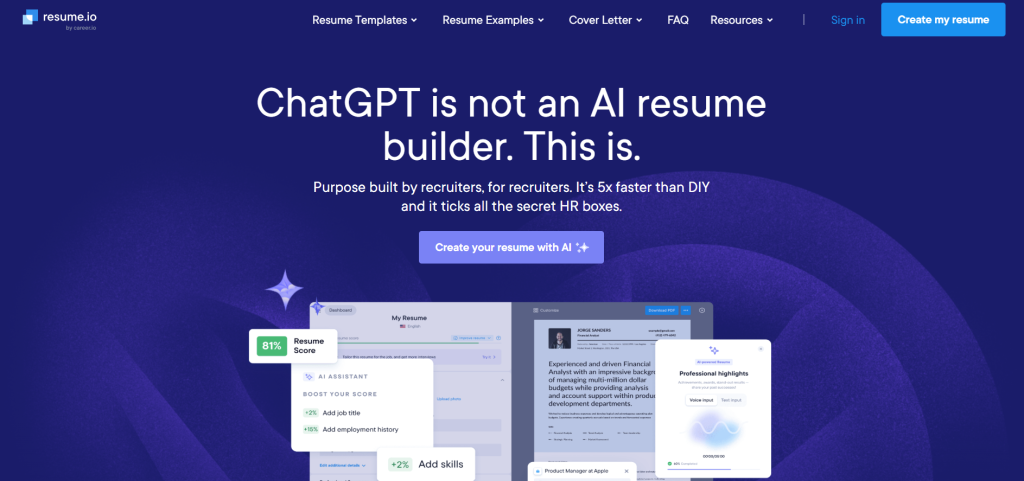
What it does: The built-in AI writing assistant helps job seekers draft professional summaries, job duty bullet points, and skill sections using recruiter-trained language.
How it works & testing evaluation: When filling out your work history, the AI analyzes your job title and generates pre-written phrases packed with strong action verbs. During my testing of the AI resume builder, entering a title like "Marketing Manager" generated dozens of relevant bullet points covering campaign tracking, team leadership, and strategy. The writing quality is clean and grammatically accurate, making it far superior to basic spellcheckers. However, while the pre-written phrases provide excellent speed, they tend to be somewhat generic. You will still need to manually edit the text to add specific metrics, such as revenue figures or project percentages, so your resume accurately reflects your actual achievements. Entry-level job seekers and career switchers will benefit most from this feature because it eliminates writer's block instantly.
2. ATS-Friendly Resume Templates
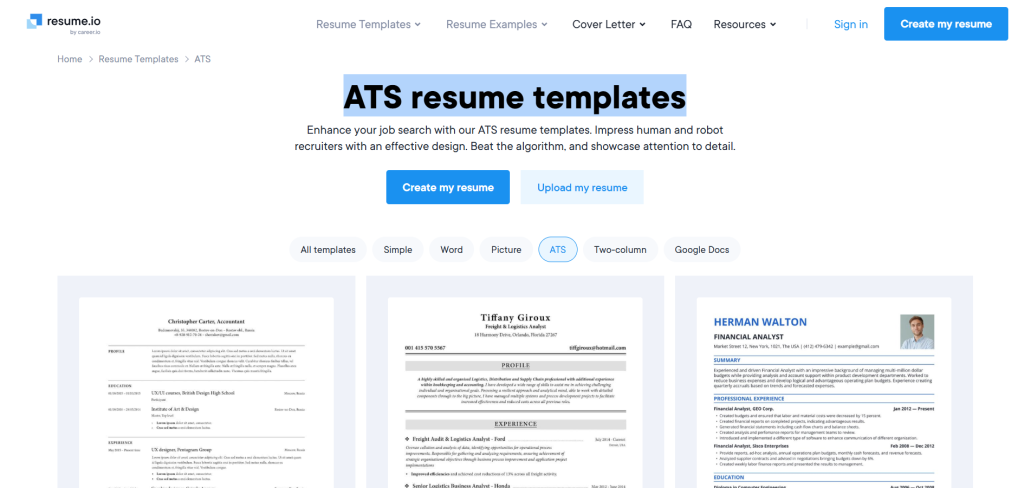
What it does: Resume.io provides a collection of professionally designed Resume.io templates built to pass Applicant Tracking System (ATS) software parsing.
How it works & testing evaluation: The platform offers over 30 design layouts categorized into Professional, Modern, Creative, and Simple styles. Dedicated ATS layouts like "Pure ATS" and "Prime ATS" avoid complex graphics, tables, or multi-column text blocks that confuse automated recruiter scanners. During testing, switching between template designs was seamless—content adapted instantly without breaking paragraph alignment or header spacing. The template quality is sleek, making it ideal for corporate candidates who need an effective ATS resume builder format. The primary limitation is that design flexibility within templates is somewhat strict; you cannot freely move text boxes wherever you want, which prevents accidental layout errors but limits heavy graphic customization.
3. AI Cover Letter Generator
What it does: This feature automatically drafts a customized cover letter that matches the exact visual styling and content tone of your resume.
How it works & testing evaluation: By selecting your target role and key accomplishments, the generator produces a structured multi-paragraph letter in seconds. In my testing, the AI cover letter tool accurately pulled my past job titles and skills into a coherent narrative. The tone was professional, formal, and well-structured. However, like most automated tools, the draft can sound slightly formulaic if left completely unedited. Spending two minutes tweaking the opening and closing lines makes a massive difference in personalization. Anyone applying to multiple jobs who wants a matching application package quickly will find this tool extremely valuable.
4. Resume Import (PDF & LinkedIn)
What it does: Allows users to import existing work history from an uploaded PDF resume or LinkedIn profile to avoid typing everything manually.
How it works & testing evaluation: When uploading a past PDF resume, the platform parses job titles, employment dates, education history, and bullet points into the editor fields. During testing, the import accuracy was surprisingly solid for standard layouts, extracting around 90% of my test document correctly. If your original resume uses unusual multi-column formats or heavy graphics, some section text may land in the wrong field, requiring minor manual cleanup. Nevertheless, for candidates updating an old resume, this import feature speeds up the initial setup dramatically.
5. Resume Customization & Formatting Flexibility
What it does: Gives candidates control over layout spacing, section ordering, color palettes, and typography settings.
How it works & testing evaluation: The customization panel includes simple sliders to adjust line height, font size, and section margins. Reordering sections—such as moving Education above Work Experience for a recent graduate—takes a single click. During testing, real-time visual previews updated instantly, making editing effortless. Where it struggles is micro-level design control: you cannot change individual font sizes for isolated words or adjust margins beyond set threshold limits. This structured approach benefits beginners by keeping layout integrity intact for screeners.
6. Job Description Matching & Keyword Optimization
What it does: Compares your draft against a specific job posting to highlight missing keywords and improve job relevance.
How it works & testing evaluation: By pasting a job description link or text block into the optimizer, the tool identifies essential skills and industry terms missing from your draft. In testing, it accurately flagged missing technical competencies for developer and project management roles. Adding those suggested keywords improves candidate relevance when scanned by an ATS resume builder system. However, candidates should avoid blindly accepting every keyword suggestion to prevent keyword stuffing. It is best used as a practical audit guide before submitting your application.
7. Integrated Career Tools
What it does: Expands beyond document creation by offering an integrated job application tracker, interview prep resources, and career guides.
How it works & testing evaluation: The dashboard includes a simple Kanban-style job tracker to log application statuses from "Applied" to "Interview Scheduled." In testing, the tracker was clean and convenient for keeping active job searches organized in one place. While it does not replace dedicated enterprise job search platforms, having job tracking alongside document creation adds genuine value for active job hunters managing multiple applications simultaneously.
8. Resume Export Options
What it does: Allows users to download completed resumes and cover letters in PDF or TXT formats.
How it works & testing evaluation: Downloading a PDF produces a crisp, high-resolution document where text remains fully selectable and searchable for ATS software. During testing, PDF exports rendered identically to the on-screen preview. The biggest limitation is pricing access: free plan users are restricted to downloading a plain TXT file without template formatting, while PDF downloads require a paid trial or active subscription.
9. Mobile and Desktop User Experience
What it does: Provides a responsive web application designed for editing resumes on both desktop computers and mobile devices.
How it works & testing evaluation: The desktop experience is smooth, with auto-save protecting your work during unexpected browser crashes. On mobile devices, the interface adapts surprisingly well, allowing users to make quick text edits or generate cover letters on the go. While major resume overhauls are still easier on a desktop monitor, the mobile site is fast, intuitive, and responsive for quick updates.
Step-by-Step: How to Build Your Resume on Resume.io in 2026
Getting started is refreshingly simple:
- Sign up for free and choose a template.
- Import data from LinkedIn, upload an old PDF, or start fresh.
- Let AI take over—describe your roles, and watch it generate content.
- Paste a target job posting for instant tailoring.
- Review suggestions, add quantifiable achievements (numbers matter!), and tweak until it sounds like you.
- Download as PDF (paid plans) or TXT (free tier).
The interface feels modern and intuitive on both desktop and mobile. Auto-save keeps everything safe, and the spell-checker catches embarrassing typos before they reach a recruiter.
Pricing Plans: What You Actually Get in 2026
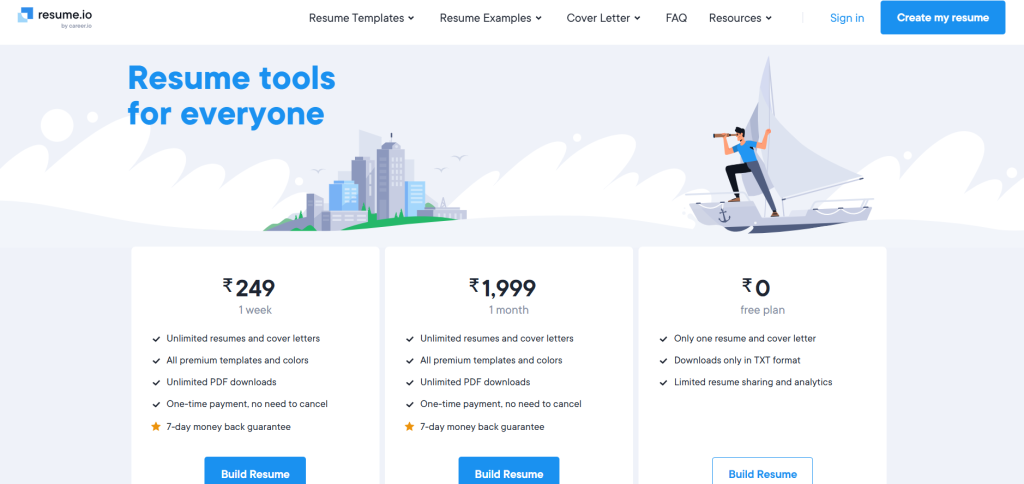
Understanding Resume.io pricing is essential before signing up. The platform operates on a freemium and subscription model rather than charging a one-time fee per document. While anyone can create a draft for free, downloading a finished PDF resume requires a paid Resume.io Premium plan or a low-cost trial membership. Pricing can vary slightly depending on your geographic region and active promotional discounts, but the core plan structure in Resume.io 2026 remains consistent globally.
| Plan | Price | Best For | Main Features | Limitations |
|---|---|---|---|---|
| Free Plan | $0 | Basic testing & drafting | 1 draft resume, basic editor, TXT file export | No PDF downloads, no premium templates, limited AI suggestions |
| 7-Day Trial | $2.95 – $4.95 | Short-term job applicants | Unlimited PDF exports, all ATS templates, full AI writing, cover letters | Auto-renews at $24.95 – $29.95/month if not canceled |
| Monthly Premium | $24.95 / month | Active job hunters | Unlimited resumes & cover letters, job tracking, full AI assistant | Recurring monthly billing model |
| 6-Month Plan | $44.95 / 6 months | Long-term career planning | All Premium features unlocked at a lower monthly rate | Billed as a single upfront payment |
For this hands-on Resume.io review, I evaluated each tier to determine which option offers genuine value and which you should approach with caution. The Free plan works well as a sandbox to test the editor's interface and preview how your information looks. However, it is not sufficient for most active job seekers because it only allows plain TXT text exports, stripped of all visual layout styling and template formatting.
The 7-Day Trial is the most popular starting point because it gives complete access to the Resume.io AI Resume Builder, all premium Resume.io templates, and high-resolution PDF exports for under five dollars. If you only need to build one resume and matching cover letter quickly, the trial offers great short-term value. However, you must keep billing management in mind: unless you manually cancel the trial inside your account settings before the seven days expire, it automatically rolls into a recurring monthly subscription at $24.95 to $29.95 every four weeks. Users frequently mention this auto-renewal policy in online discussions, so setting a personal reminder to cancel is critical if you do not plan to stay long-term.
The 6-Month plan provides the best long-term value for candidates anticipating an extended job search, bringing the effective monthly cost down significantly compared to paying month-to-month. Premium plans include extra career features like job application tracking, profile sharing, and automated cover letter generation, which help justify the cost for active applicants submitting dozens of tailored documents.
Is Resume.io Worth the Price?
Determining whether Resume.io is worth paying for depends on your personal job-seeking timeline and formatting needs. If you struggle with resume layout design and want a fast AI resume builder that delivers recruiter-trained phrasing and an effective ATS resume builder layout, paying for a short-term trial or monthly plan is a practical investment. The AI writing tools save hours of drafting time, and the cohesive cover letter pairing makes your application look polished.
However, if you are on a tight budget or already possess strong formatting skills in traditional word processors, recurring subscription costs may feel unnecessary. Overall, Resume.io provides excellent software quality and workflow efficiency, but it is best utilized by job seekers who take advantage of the trial period strategically or actively use its full suit of career management tools.
Real User Experiences: What the Community Says
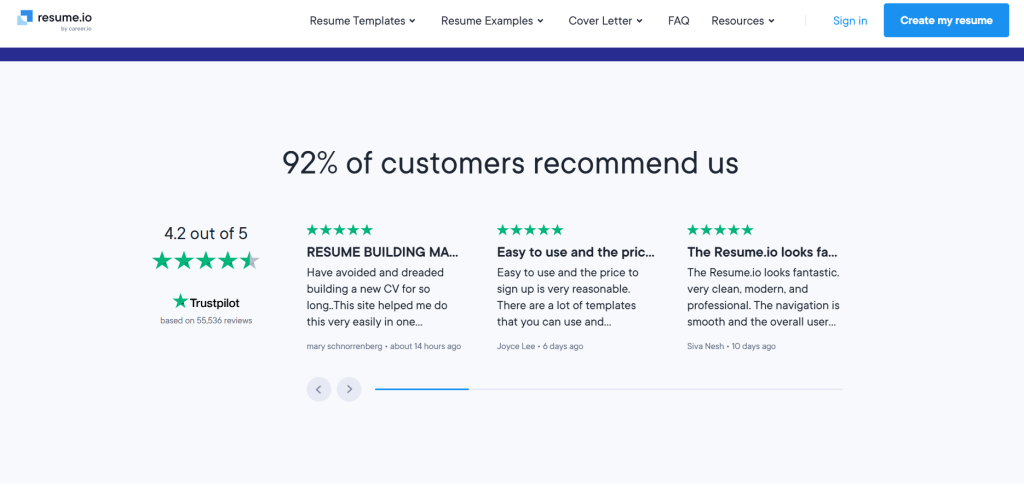
To supplement my hands-on evaluation for this Resume.io review, I analyzed thousands of public Resume.io reviews across major feedback platforms including Trustpilot, Reddit, G2, and Capterra. On Resume.io Trustpilot, the platform maintains a strong rating of over 4.2 out of 5 stars across more than 50,000 user submissions. However, examining discussions on Resume.io Reddit threads reveals a more nuanced picture regarding subscription management and content customization.
1. What Users Like
Across review sites, positive feedback highlights workflow speed and visual design quality:
- Exceptional Ease of Use: Beginners repeatedly praise the step-by-step editor interface for taking the stress out of document formatting.
- Clean ATS-Friendly Templates: Job seekers appreciate that the pre-formatted layouts look professional while meeting standard screening software requirements.
- Fast Content Generation: Users report that the AI resume builder and matching cover letter generator save hours of writing time during active job hunts.
- Polished Visual Customization: Candidates like being able to change color schemes, fonts, and layout spacing without breaking section alignment.
2. Common Complaints & Criticisms
Despite high overall satisfaction scores, recurring criticisms focus primarily on billing practices and free tier constraints:
- Subscription Auto-Renewals: The single most frequent complaint on Reddit involves the 7-day trial automatically converting into a recurring monthly subscription if not explicitly canceled before expiration.
- Cancellation Confusion: Some users report difficulty locating the cancellation button within account settings, leading to unexpected charges.
- Restricted Free Tier: Job seekers express disappointment that the free plan only provides a plain TXT download instead of a formatted PDF file.
- AI Suggestions Require Editing: Multiple reviewers note that pre-written AI bullet points can sound repetitive if candidates do not manually customize them with specific metrics.
3. My Take After Comparing Community Feedback
Comparing my personal testing results with broader community sentiment confirms that Resume.io is a top-tier document builder with transparent software strengths and predictable subscription gotchas. User praise for its speed, template aesthetics, and cover letter pairing mirrors my own experience—the editor is genuinely fast and beginner-friendly. Likewise, community complaints regarding subscription renewals match my recommendation to manage trial billing carefully. Overall, if you understand the subscription model and actively edit the generated content, the Resume.io AI Resume Builder delivers a dependable, high-quality user experience.
How Resume.io Compares to Other Top AI Builders in 2026
Choosing the best AI resume builder depends heavily on your specific job search priorities and career background. While conducting this Resume.io review, I evaluated the Resume.io AI Resume Builder side-by-side with its strongest market competitors in 2026: Rezi AI, Kickresume, Teal, and Enhancv. Each platform takes a distinct approach to AI writing assistance, ATS optimization rigor, template customization, and pricing models.
Resume.io vs Rezi AI
Best use case: Rezi is tailored specifically for applicants applying to corporate enterprises where passing strict ATS screening software is the primary objective.
Detailed comparison: In the Resume.io vs Rezi matchup, Rezi leads in mathematical ATS scoring and keyword density targeting. Rezi provides real-time ATS audit scores and strict single-column layouts that guarantee parsing across conservative hiring systems. However, Resume.io outperforms Rezi in interface design, beginner friendliness, and matching cover letter generation. While Rezi's AI content suggestions focus heavily on keyword frequency, Resume.io offers smoother AI writing quality and more visually appealing templates. Rezi offers a lifetime access pricing option, whereas Resume.io relies on subscription pricing. Choose Rezi if passing strict ATS screeners is your sole objective; choose Resume.io if you want an easier, visually polished builder with matching cover letters.
Resume.io vs Kickresume
Best use case: Kickresume is ideal for creative professionals, designers, and media candidates who want visually striking, high-graphic resumes.
Detailed comparison: Comparing Resume.io vs Kickresume reveals a clear contrast between clean corporate design and creative artistic layouts. Kickresume offers stunning graphic templates, AI resume writing, AI cover letter generation, and an automated portfolio web page builder. Kickresume's AI writing features rapid content drafting from job titles. However, Kickresume's heavier design elements can occasionally struggle with conservative ATS parsers compared to Resume.io's dedicated ATS templates. Resume.io is much easier for beginners to navigate, providing structured editing controls that prevent accidental layout breaks. Choose Kickresume for creative roles in design or marketing; choose Resume.io for corporate, finance, or general business applications.
Resume.io vs Teal
Best use case: Teal is built for active job seekers who prioritize comprehensive job application tracking and pipeline management.
Detailed comparison: Evaluating Resume.io vs Teal highlights different core platform strengths. Teal operates primarily as a career growth hub with a powerful Chrome extension that imports job postings from LinkedIn and job boards directly into a Kanban tracking dashboard. Teal's AI resume tools allow you to match work experience bullet points against target job descriptions effectively. However, Teal's resume builder interface feels less intuitive for first-time users, and its template designs are more basic compared to Resume.io's polished template collection. Resume.io offers faster AI cover letter generation and a smoother document-building workflow. Choose Teal if you manage a heavy, multi-application pipeline; choose Resume.io if you want a faster, all-in-one document creator.
Resume.io vs Enhancv
Best use case: Enhancv is designed for mid-level and executive professionals who want modern, storytelling-focused resume layouts.
Detailed comparison: Enhancv excels at personal branding, offering unique resume sections for core values, major achievements, and visual career timelines. Enhancv's AI assistant provides strong feedback on bullet point impact and readability. However, Enhancv is significantly more expensive than Resume.io and has a steeper learning curve for non-technical users. Resume.io delivers better pricing value, faster AI generation, and simpler navigation while still providing ATS-compliant designs. Choose Enhancv for executive storytelling; choose Resume.io for practical, cost-effective job applications.
| Tool | Best For | ATS Support | AI Writing | Templates | Pricing | Overall Rating |
|---|---|---|---|---|---|---|
| Resume.io | All-in-one speed & ease | Strong (Dedicated ATS templates) | Good (Recruiter-trained) | 30+ Sleek styles | $2.95 trial / $24.95 mo | 8.8 / 10 |
| Rezi AI | Strict ATS optimization | Excellent (Rezi Score audit) | Keyword-focused | Basic ATS layouts | $29/mo or Lifetime | 8.7 / 10 |
| Kickresume | Creative & visual designs | Moderate (Varies by template) | Creative & Fast | High-graphic styles | $19/mo or Annual | 8.6 / 10 |
| Teal | Job tracking & pipeline mgmt | Good (Keyword matching) | Job-tailored | Clean & simple | Free tier / $29 mo | 8.5 / 10 |
| Enhancv | Executive storytelling | Good (Modern ATS standards) | Impact-focused | Modern & modular | $24.99/mo (Quarterly) | 8.4 / 10 |
Which Resume Builder Should You Choose?
Selecting the right platform comes down to your primary career goals and technical preferences:
- Best for beginners: Resume.io offers the smoothest step-by-step editor, structured layout controls, and an intuitive interface that prevents formatting mistakes.
- Best ATS optimization: Rezi AI provides the most rigorous real-time ATS scoring and keyword analysis for corporate screening software.
- Best design & creativity: Kickresume delivers the most visually stunning, graphic-rich templates for creative and media industries.
- Best job tracking value: Teal offers the strongest free job application tracking system for candidates applying to dozens of roles weekly.
- Best all-in-one platform: Resume.io strikes the best overall balance between AI content generation, ATS template compliance, matching cover letters, and workflow speed in 2026.
Pros and Cons of Resume.io AI Resume Builder
Every software tool comes with its own set of advantages and operational trade-offs. While conducting this Resume.io review, I analyzed how the platform balances automation speed against customization depth. Understanding the Resume.io pros and cons will help you decide whether this AI resume builder fits your specific career timeline and budget.
Pros
- Recruiter-Trained AI Writing: Generates polished, action-oriented bullet points based on hiring data, which matters because it instantly eliminates writer's block and ensures your work history sounds professional.
- ATS-Friendly Resume Templates: Provides clean, single-column ATS resume builder layouts, which matters because it prevents automated applicant screening software from misreading your work experience.
- Integrated AI Cover Letter Generator: Automatically creates a matching cover letter using the visual styling of your resume, which matters because it saves time while presenting a cohesive application package to recruiters.
- Fast Resume Creation & Import: Allows candidates to import old PDF resumes or LinkedIn profiles, which matters because it lets you draft a finished application in under fifteen minutes instead of typing everything manually.
- Beginner-Friendly Interface: Uses structured layout controls and real-time visual previews, which matters because non-technical users can customize typography, colors, and section order without breaking page alignment.
- Integrated Career Tools: Includes an application tracker and interview resources alongside document creation, which matters because active job seekers can manage their entire application pipeline in one place.
Cons
- Restricted Free Version: The free tier limits users to plain TXT file downloads without visual formatting, meaning you cannot download a finished PDF resume without a paid trial or subscription.
- Subscription Pricing & Auto-Renewals: The platform operates on a recurring billing model where short-term trials automatically roll into monthly charges if not explicitly canceled before expiration.
- AI Suggestions Require Editing: Pre-written content phrases can sound generic across multiple applicants, meaning job seekers must still spend time adding personal metrics and specific achievements.
- Premium Features Behind a Paywall: Full PDF exports, unlimited document creation, and advanced job matching features are strictly reserved for paying subscribers.
My Overall Opinion
Overall, the strengths of Resume.io outweigh its weaknesses for candidates who need a fast, structured, and visually clean resume builder. While recurring subscription costs and free-tier PDF export restrictions require careful account management, the platform's recruiter-trained AI writing, ATS-compliant layouts, and seamless cover letter pairing make it a highly practical tool for modern job applications.
Pro Tips to Maximize Your Resume.io Experience
Using an AI resume builder can significantly accelerate your application workflow, but technology alone will not land you a job. In this Resume.io review, I found that the best results come when you combine automated software tools with thoughtful human editing and personal oversight. Here are practical Resume.io tips and proven resume writing tips to help you get the most out of the Resume.io AI Resume Builder in 2026.
Start with Accurate Work History
Input genuine job titles, employment dates, and core responsibilities before activating AI generation. Having accurate base data allows the AI writer to suggest far more relevant bullet points.
Personalize Every AI-Generated Section
Treat AI-generated summaries and bullet points as starting drafts rather than final submissions. Adding your genuine tone and specific career details prevents your application from sounding generic to hiring managers.
Quantify Achievements with Measurable Results
Include specific numbers, percentages, dollar amounts, or team sizes in your experience section. Stating that you "increased sales by 30%" carries far more impact than simply saying you "improved sales performance."
Tailor Your Resume for Every Job Posting
Use the built-in job description analyzer to compare your draft against target job listings. Incorporating role-specific keywords improves text alignment for ATS resume builder systems.
Choose Dedicated ATS Templates for Online Submissions
Opt for clean single-column layouts like "Pure ATS" or "Prime ATS" when submitting applications through corporate portals. Simple designs ensure automated software parses your work history cleanly.
Keep Formatting Clean and Uncluttered
Resist the urge to over-customize font sizes, margins, or color palettes. Standard margins and professional typography maintain document readability for human screeners.
Generate a Matching Cover Letter
Take advantage of automated cover letter pairing to create a matching cover letter with identical design themes, presenting a cohesive application package to employers.
Proofread Thoroughly Before Exporting
Always conduct a final review for typos, grammatical flow, and date alignment before downloading your PDF file. Even advanced AI editors can occasionally miss context-specific phrasing errors.
Save Multiple Versions for Different Roles
Duplicate and save custom resume variations tailored to different job titles or industries. Having targeted versions ready speeds up the application process significantly.
Update Your Resume Regularly
Add new certifications, skills, and project milestones as they occur rather than waiting until you actively start job hunting again.
My Best Tip
My single most valuable recommendation from hands-on testing is to use Resume.io as a drafting and structuring assistant rather than a hands-off replacement for your own professional judgment. The platform excels at building clean ATS layouts, generating structured bullet points, and creating cohesive cover letters in minutes. However, no software can invent authentic achievements or guarantee interview callbacks. Taking ten minutes to manually refine AI suggestions with real metrics and personal accomplishments makes all the difference between a generic application and a compelling, interview-ready resume.
Final Verdict
Overall Rating: 8.8/10
The Resume.io AI Resume Builder stands out as one of the most reliable, efficient, and user-friendly career platforms available in Resume.io 2026. Throughout this hands-on Resume.io review, the platform demonstrated consistently strong performance by combining recruiter-trained AI writing assistance, clean single-column ATS resume builder templates, automated cover letter pairing, and an effortless drag-and-drop editor interface. It excels at eliminating formatting frustration, allowing both entry-level candidates and executive professionals to assemble complete, polished application packages in minutes. While it is not completely flawless due to free-tier export restrictions and recurring subscription renewals, its core software capabilities provide genuine value for modern job applicants navigating competitive hiring software.
Who Should Use Resume.io?
Resume.io is an ideal choice for students and fresh graduates who need structured guidance to create their first professional resume. It is equally valuable for career changers who want AI assistance to reframe transferable skills for new industries, experienced mid-level managers updating long work histories, and active job seekers submitting tailored applications to multiple positions weekly. Anyone who values document creation speed, cohesive visual styling, and an intuitive beginner-friendly interface will benefit greatly from its feature set.
Who Might Want an Alternative?
Candidates seeking a completely free tool without any subscription commitment will find Resume.io's free tier too restrictive for formal submissions. Furthermore, applicants applying to corporate enterprise positions who require mathematical keyword density audits may prefer specialized ATS tools like Rezi AI. Creative professionals in design or media who want graphic-heavy layouts will be better served by platforms like Kickresume, while occasional job seekers who only update their resume once every few years may want to avoid subscription-based software entirely.
Is Resume.io Worth Paying For in 2026?
Evaluating Resume.io pricing leads to a clear conclusion: whether Resume.io is worth paying for depends on how actively you are job hunting. The Free plan is useful for exploring template designs and drafting content, but its plain TXT export limitation makes it insufficient for formal job applications. The low-cost 7-day trial and short-term Premium plans deliver exceptional value if you need to build formatted PDF resumes and matching cover letters quickly. Provided you manage your subscription settings vigilantly to prevent unwanted auto-renewals, paying for short-term premium access easily justifies the cost by saving hours of formatting time.
Ultimately, if you are actively searching for a new position and want a versatile AI resume builder that delivers recruiter-aligned bullet points, ATS-compliant layouts, and cohesive cover letters without technical hassle, Resume.io remains one of the strongest overall recommendations for job seekers in 2026.